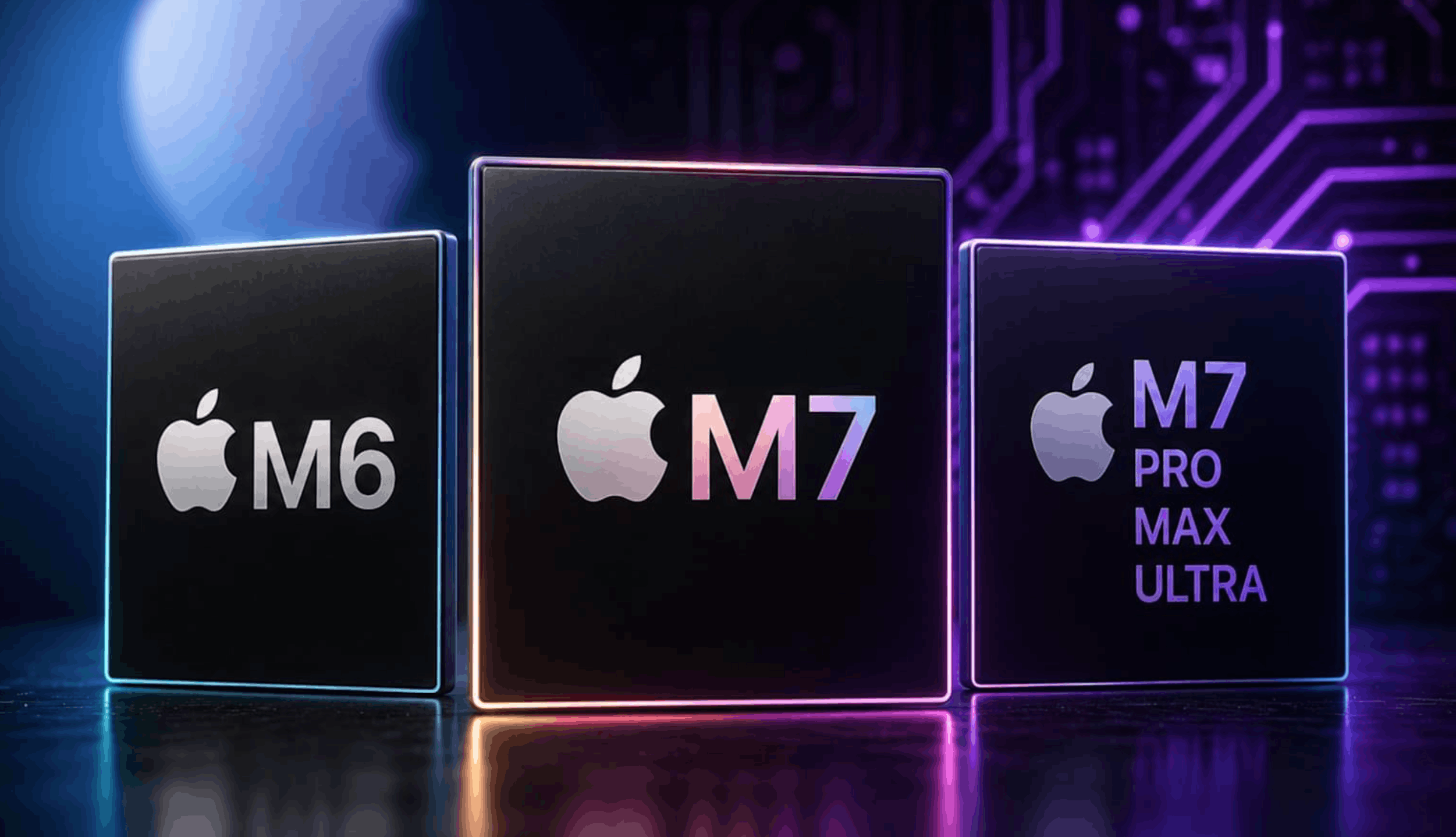
Apple’s upcoming M7 Ultra chip is designed to support up to 1.5 terabytes (TB) of unified memory, according to Bloomberg’s Mark Gurman in his July 12 Power On newsletter. That would roughly double the M5 Ultra’s reported 768GB ceiling and match the 2019 Intel Mac Pro’s 1.5TB maximum – the first time Apple silicon has reached that figure. Gurman says the M7 Ultra Mac Studio is targeted for 2028, and whether Apple actually ships a 1.5TB configuration will depend on memory-industry conditions.
TL;DR
- Apple’s M7 Ultra is reportedly designed for up to 1.5TB of unified memory (Bloomberg’s Mark Gurman, July 12 Power On newsletter).
- That would roughly double the M5 Ultra’s reported 768GB and match the 2019 Intel Mac Pro’s 1.5TB – a first for Apple silicon.
- Today’s peak is 512GB (M3 Ultra Mac Studio, 2025), though Apple now configures that model up to 96GB.
- The M7 Ultra Mac Studio is targeted for 2028; the M5 Ultra version is due this year.
- Whether Apple ships a 1.5TB config depends on DRAM-market conditions, and there’s no pricing yet.
If you’ve ever tried to run a large AI model on your own Mac and watched it choke the moment it ran out of memory, this one’s for you. Gurman’s latest report points to a future Mac Studio that could hold more memory than a lot of small servers, and it’s aimed squarely at the AI workloads that are eating RAM for breakfast. Here’s what’s been reported, what it actually means, and whether it’s worth holding out for.
What did Gurman actually report?
Gurman reports that Apple is engineering the M7 Ultra “to support as much as 1.5 terabytes of memory” – about double the maximum expected for the M5 Ultra. The detail came from his July 12 Power On newsletter, where he laid out Apple’s chip roadmap through the M8 generation.
He frames two Mac Studio updates in the pipeline: an M5 Ultra version due this year, and an M7 Ultra model targeted for 2028. There’s one caveat you shouldn’t skip – Gurman notes that whether Apple ships a machine at that memory ceiling hinges on the state of the DRAM market, which has been tight. So read 1.5TB as what the silicon is designed to allow, not a config you’re guaranteed to be able to buy.
How much unified memory can a Mac hold today?
Right now the ceiling that Apple silicon has actually reached is 512GB, on the M3 Ultra Mac Studio launched in early 2025 – which Apple called “the most unified memory ever in a personal computer” (Apple newsroom). Worth knowing: Apple has since pared that model’s order page back to a 96GB maximum, so the biggest config you can actually buy today is smaller than the peak it once hit. Here’s how the Ultra tier has climbed.
| Chip / machine | Year | Max unified memory | Notes |
|---|---|---|---|
| Mac Pro (Intel) | 2019 | 1.5TB DDR4 ECC | Top 24- and 28-core configs only, across 12 DIMM slots |
| M1 Ultra (Mac Studio) | 2022 | 128GB | First Ultra |
| M2 Ultra (Mac Studio / Mac Pro) | 2023 | 192GB | – |
| M3 Ultra (Mac Studio) | 2025 | 512GB | “Most ever in a personal computer” (Apple); now sold up to 96GB |
| M5 Ultra (Mac Studio) | Due this year (reported) | ~768GB (reported) | Supply-dependent |
| M7 Ultra (Mac Studio) | Targeted 2028 (reported) | Up to 1.5TB (reported) | Ships at that size only if DRAM conditions allow |
Why does 1.5TB of unified memory matter?
Because on Apple silicon the CPU, GPU, and Neural Engine all draw from one shared pool – so a bigger pool means you can load bigger AI models entirely on-device, with no copying back and forth between system RAM and separate video memory.
When you run a local large language model, the whole thing has to fit in memory or performance falls off a cliff. On a 64GB Mac today you’re comfortable with mid-size models and quantized versions of the big ones; push past that and you’re either swapping or you simply can’t load the weights. A 1.5TB pool changes the maths completely – now you’re talking about holding very large models, long context windows, and several workloads at once that currently need a rack of GPUs. That’s the real target here. Apple’s M7 family, reportedly codenamed “Andros,” is said to be built around a much stronger Neural Engine, and a huge unified memory pool is the other half of that story.
Does 1.5TB really match the 2019 Mac Pro?
Yes. The 2019 Intel Mac Pro topped out at exactly 1.5TB of DDR4 ECC memory, and the M7 Ultra would be the first Apple-silicon chip designed to reach the same ceiling.
There’s a catch worth flagging, though. That old Mac Pro hit 1.5TB across twelve user-accessible DIMM slots, and only in its most expensive 24- and 28-core builds. Apple silicon does it with memory packaged on the chip – much higher bandwidth, but not something you can upgrade later. For pro users that’s the trade they’ve made since 2020: you lose the slots, you gain the speed. Matching that 1.5TB number finally closes a symbolic gap that’s been open since Apple walked away from Intel.
How does Apple’s unified memory compare to Nvidia and AMD?
Apple’s approach lets a single machine address far more memory for AI than any consumer discrete graphics card, because it isn’t boxed in by separate video memory – though raw compute is a different fight.
Consumer GPUs from Nvidia and AMD generally top out around 24-32GB of dedicated VRAM, and even pricey data-center accelerators sit well under a terabyte per card. To hold a genuinely large model on that hardware, you chain several expensive GPUs together. Apple’s pitch is that one Mac Studio with a massive unified pool can carry what used to need that whole cluster. It won’t out-muscle a room full of Nvidia accelerators on throughput, and I wouldn’t pretend otherwise. But for memory capacity per box – and for a developer who just wants a big model running quietly on a desk – that’s a genuinely different value proposition.
When is the M7 Ultra coming, and how much will it cost?
Gurman targets the M7 Ultra Mac Studio for 2028. There’s no pricing information, and Apple hasn’t announced the chip – so don’t trust any firm figure you see.
The nearer-term update is the M5 Ultra Mac Studio, which Gurman says is due this year. (Some outlets, like Macworld, narrow that to around October 2026 on DRAM-shortage grounds, but Gurman himself has only said “this year.”) Beyond that, the reported cadence has a base M6 arriving in late 2026, the M7 line kicking off in early 2027, and M7 Pro and Max variants by the end of 2027 before the Ultra lands in 2028. Apple hasn’t publicly committed to any of those dates, so treat them as reporting rather than a schedule.
| Chip | Reported timing | What’s reported |
|---|---|---|
| M6 (base) | Late 2026 | Apple reportedly skips higher-end M6 Pro/Max variants |
| M7 (base) | Early 2027 | “Andros” family; big Neural Engine upgrade for on-device AI |
| M7 Pro / M7 Max | End of 2027 | – |
| M7 Ultra | 2028 (Gurman’s target) | Designed for up to 1.5TB unified memory |
| M8 | In development | Reportedly already underway for further AI gains |
Gurman’s firm statements are narrower – an M5 Ultra “due this year,” an M7 Ultra “targeted for 2028,” and Apple “already developing M8.” The intermediate 2026-2027 dates come from outlets unpacking his Power On reporting (9to5Mac), not from Apple.
Should you wait for the M7 Ultra?
For almost everyone, no. It’s roughly two years out, unannounced, and its headline 1.5TB config may never ship at that size.
If you need a high-memory Mac now, the current M3 Ultra Mac Studio or the M5 Ultra model due this year are the realistic buys. The M7 Ultra is only worth holding out for if your work genuinely lives or dies on extreme on-device memory – training or serving very large models locally – and even then, I’d wait for Apple to confirm the chip and the real shipping memory options before banking on 1.5TB. Rumored ceilings have a habit of shrinking by the time they reach a price list. Case in point: Apple already quietly walked the M3 Ultra Mac Studio back from its 512GB peak to a 96GB-max order page. What a chip is designed to allow and what you can actually buy aren’t always the same number.







Leave a Reply