TL;DR
- The iPhone 17 Pro Max starts at $1,299 for 256GB, rising to $1,599 for 512GB and $1,799 for 1TB.
- Its main rivals are priced lower: Samsung Galaxy S24 Ultra $1,299, Google Pixel 9 Pro $999, and OnePlus 13 Pro $899.
- Apple runs the A19 Bionic chip against Samsung’s Snapdragon 8 Gen 4, Google’s Tensor G4, and OnePlus’s custom Snapdragon.
- The iPhone’s display is a 6.8-inch ProMotion OLED at 120Hz refresh with 2,500 nits of brightness.
- The piece frames Apple’s premium as buying ecosystem and better resale value, while OnePlus is pitched as the cheaper alternative.
The 2024 flagship sector is a crowded one, as companies compete on design and cost. Phones are touted as being “the best of 2024,” as customers have no choice but to compare feature vs. price. The iPhone 17 Pro Max is distinct, but is it better than Samsung, Google, or OnePlus?
This is a cost vs. value comparison of luxury smartphones. We will pit the iPhone 17 Pro Max against current market leaders in processing power, image quality, and cost of ownership in order to crown best phone of 2024. Android or Apple, find out whether your next phone is worth it.
Flagship Rivals: Which phone is comparable with iPhone 17 Pro Max?
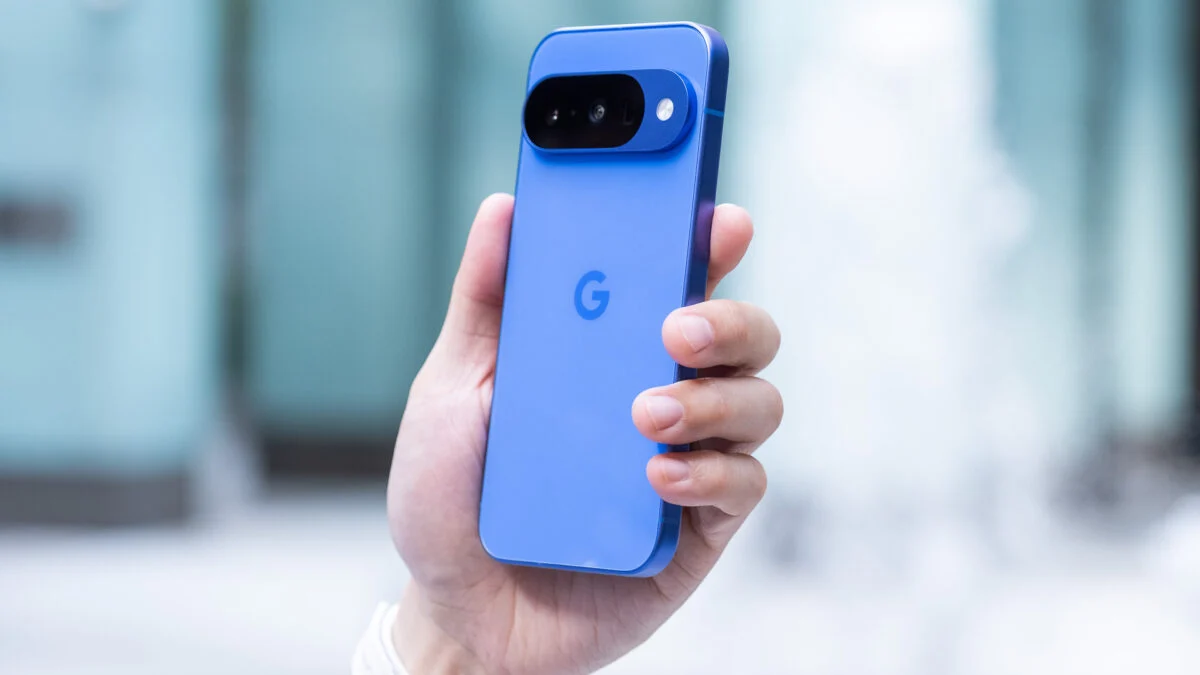
Best Androids such as Samsung Galaxy S25 Ultra, Google Pixel 9 Pro, and OnePlus 13 Pro compete with iPhone 17 Pro Max. They boast superior hardware as well as distinct software. Whereas Apple focuses on homogeneity and status, they have competing strengths, especially in price.
They perform best with high-end consumers. The Samsung Galaxy S25 Ultra is one of the world’s top-selling phones. Performance is important; Google’s Pixel 9 Pro has excellent cameras, OnePlus provides decent value. Brand prestige is essential—Apple, Samsung, Google, and OnePlus have devoted consumers with whole ecosystems.
How does it compare with iPhone 17 Pro Max? It has high-quality materials, long software updates, AI photography, and quick charging. Samsung Galaxy S25 Ultra has a huge screen and S Pen for work as well as play. Google Pixel 9 Pro has a minimalistic feel with one-click setup along with a clever camera. OnePlus is a “flagship killer,” with top-of-the-line specs at lower price points as a good iPhone 17 Pro Max alternative. Each contender does it in a distinct way. Apple iPhone 17 Pro Max does it with ecosystem and build quality, others with customization, feature, or cost. Users base it on ecosystem, use cases, long-term value, and cost in determining the best flagships.
The Apple iPhone 17 Pro Max begins at $1,299 with 256GB, $1,599 with 512GB, as well as $1,799 with 1TB. It is a high-end flagship, costing more than Android counterparts such as the Samsung Galaxy S24 Ultra as well as OnePlus 13 Pro.
The iPhone 15 Pro Max costs $1,199 at launch, reducing from last year’s $1,249 of the iPhone 16 Pro Max. This is a demonstration of Apple’s confidence in the A19 Bionic and ProMotion XDR, something that can influence annual upgrade customers.
Its rates signify a premium brand policy. Unlike price-cutting Android competition, Apple keeps rates steady in exchange for exclusivity as well as resale value. An iPhone 15 Pro Max, therefore, holds greater value than older Android flagships. How does this impact consumers? Purchase of an iPhone 17 Pro Max is entry into Apple’s software ecosystem. In spite of the price, it is a good upgrade with excellent service. Apple’s premium is worth it with improved value retention.
Rival Pricing: How Do Android Flagships Stack Up?
Prices fuel competition in flagship Androids. Both Samsung Galaxy S24 Ultra and iPhone 17 Pro Max cost $1,299, while Google Pixel 9 Pro is worth $999, and OnePlus 13 Pro is $899. These price points represent hardware quality as well as brand value. Consumers have to juxtapose initial expenses with long-term gratifications.
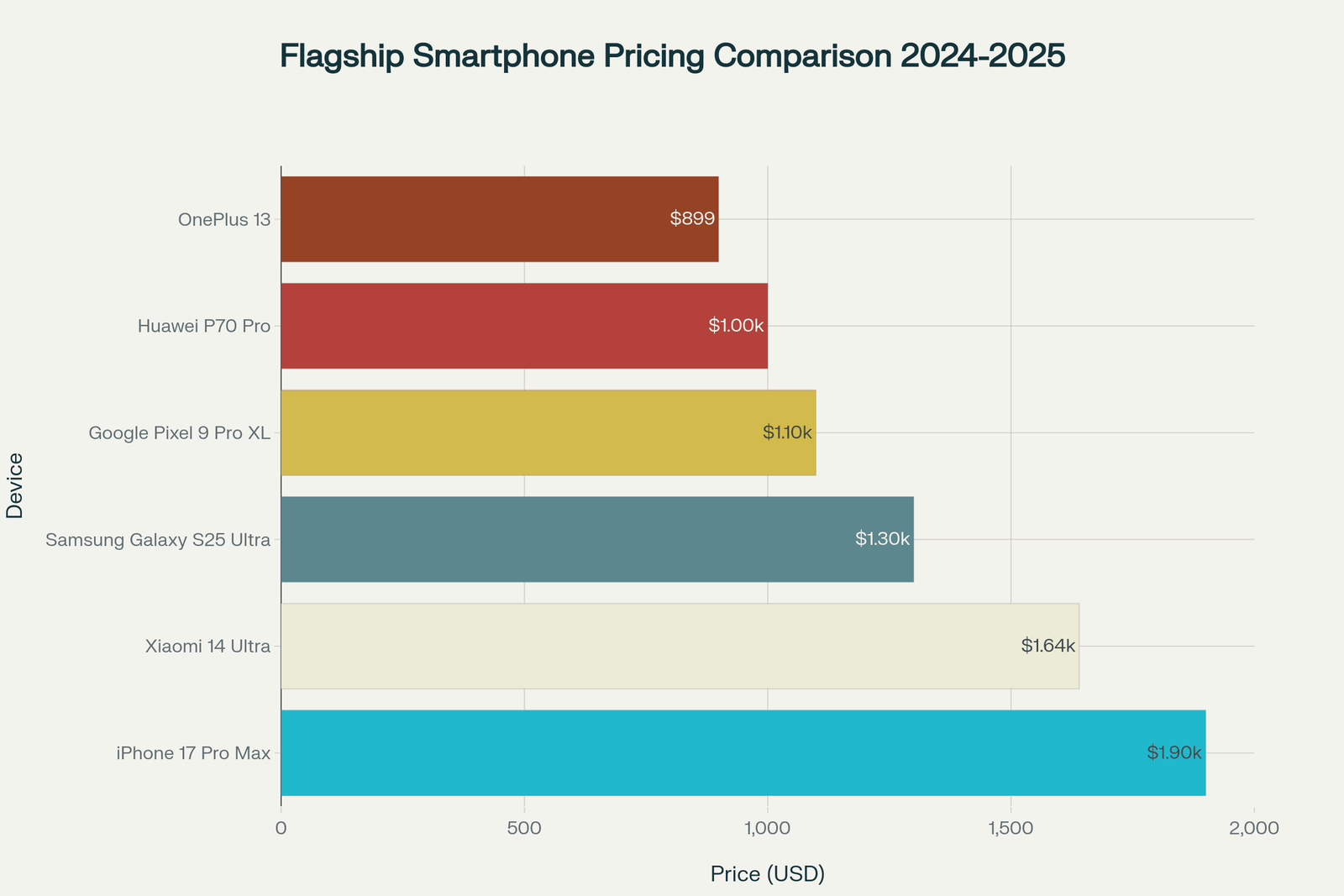
Top-brand price trends have distinct patterns. Samsung Ultra is aimed at high-end markets with premium specs. Google Pixel Pro is aimed at those desiring pure Android and AI cameras but at lower price points. OnePlus, no longer “flagship killers,” offers high-end smartphones at lower entry points. Prices usually go up per generation, but Android flagships usually have launch discounts until Apple limits offers. Prices of Android flagships originate from expensive chipsets (e.g., Snapdragon 8 Gen 3), high-end displays (LTPO AMOLED), and powerful cameras. Localization, exchange rates, and software upgrades are also added. Unlike
Apple provides a single ecosystem, whereas Android phones differ in functionalities, adding competitiveness in some markets.
The iPhone 17 Pro Max is pricy, yet high-end Android phones cost no less. Their differing prices and qualities present desirable options among consumers.
Specs Showdown: What You Should Purchase
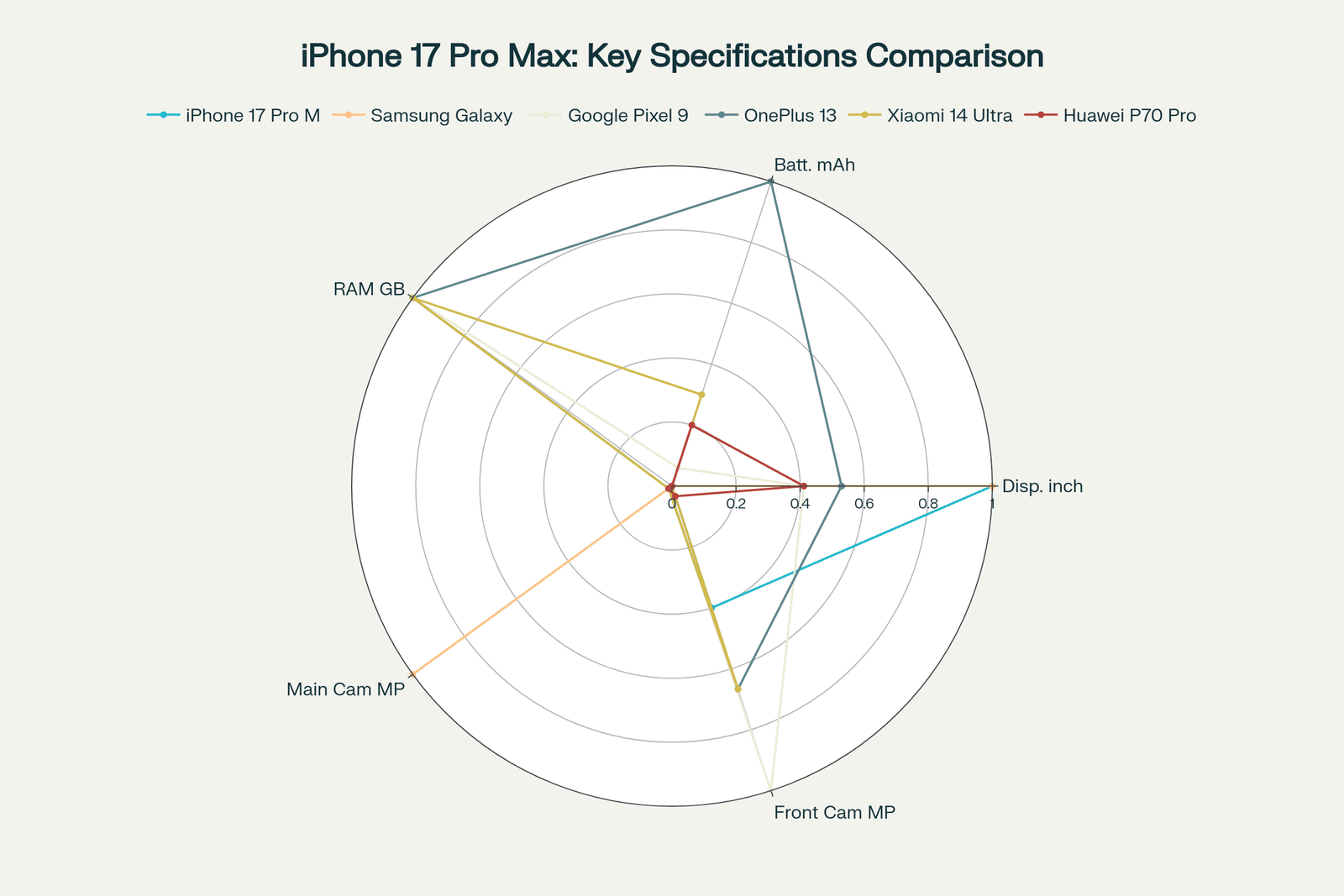
iPhone 17 Pro Max beats competitors such as the Samsung Galaxy S24 Ultra, Google Pixel 9 Pro, and OnePlus 12 Pro. Gaming and video editing are done with excellence using Apple’s A19 Bionic chip. Samsung retaliates with Snapdragon 8 Gen 4 (or Exynos) in multitasking. Google employs Tensor G4 in AI processing, while OnePlus utilizes a custom-made Snapdragon chip for improved heat dissipation.
Screen quality is important. The iPhone 17 Pro Max includes a 6.8-inch ProMotion OLED at 120Hz refresh rate with 2,500 nits of brightness. The Samsung Galaxy S24 Ultra has a larger screen with comparable rates of refresh as well as QHD+ resolution. The Pixel 9 Pro has an LTPO OLED with rich colors, while OnePlus targets gamers with its bright AMOLED screen. Battery life is “all-day” as per flagships, but testing points towards the iPhone and Samsung as topping with power-saving modes as well as power-saving chipsets.
Camera systems cost a lot and one is interested in them. The iPhone 17 Pro Max has a triple-lens arrangement with a 48MP primary sensor and decent zoom. Samsung has a quad-lens arrangement with greater megapics and diverse modes of capture. Google Pixel stands out in AI photography, particularly in low light and portrait shots, while OnePlus delivers decent performance with Hasselblad cameras. All brands have distinguishing strengths: Apple’s LiDA is best in AR; Samsung’s S Pen is best in productivity; Google is best in AI; OnePlus stands out in fast charging.
User priority is relevant. Value is worth paying for quality and ecosystem. There are good customization options with Android flagships. There are advantages in both, with value in power, screen, cameras, as well as needs.
Performance & User Experience: Beyond Specifications
Specs matter, but in-real-life performance is worth paying flagship prices. iPhone 17 Pro Max gets you A19 Bionic processor along with adequate RAM enough for multitasking. It falls behind with 4K videos or demanding apps, but Apple’s integration is at its best. Gamers enjoy adequate frame rates along with good heat handling with long playtime. Rivals such as the Samsung Galaxy S24 Ultra and OnePlus 12 Pro have up to 16GB of memory as well as Snapdragon 8 Gen 3 processing, usually leaving Apple in its rearview mirror. Android’s adaptability can result in inconsistent software.
There is a smooth interface as well as timely updates with the Google Pixel 9 Pro, but it underperforms in gaming. Phone value is dependent on ecosystem integrity and software upgrades. Upgrades on your iPhone 17 Pro Max can go as long as five years, while top-of-the-line Androids such as Samsung and Google only go as long as three or four years. These upgrades safeguard your investment as well as keep your phone up to date. There is a custom iOS 18 interface on iPhone 17 Pro Max. Android flagships shine in personalization for individuals who enjoy customizing. What will your experience be in finding your dream phone, no matter the cost?
Camera Features: Which is Best?
Camera functionality is central in flagship phones. The iPhone 17 Pro Max has a 48MP primary sensor, 10x optical zoom, and ultra-wide-angle lens, continuing Apple’s leadership in cameras. Deep Fusion adds depth of detail and color with Smart HDR. Cinematic Mode enhances subject tracking and focus in real-time in videos for superior video quality.
The Samsung Galaxy S24 Ultra is powered with a 200MP sensor along with 3x/10x telephoto lenses, competing with AI Nightography of iPhone. The Google Pixel 9 Pro is at its best in computational photography with a 50MP sensor, AI Super Res Zoom, and Night Sight.
Samsung and Apple both have 8K video recording. iPhone utilizes Post-processing with ProRes and Dolby Vision HDR. OnePlus 12 Pro is less powerful but superior in true colors with bokeh using Hasselblad. Professional videos are assisted in making with AI such as subject deletion and auto-edit.
Video is best on iPhone 17 Pro Max, zoom is best on Samsung, and point-and-shoot is best on Google Pixel. Pick according to your need—film, zoom, or light.
Battery Life & Charging: All-Day Power or Regular Top-Ups?
Battery life is essential for consumers of iPhone 17 Pro Max. It has increased capacity as well as the powerful A19 Bionic chip with a 3nm process, allowing everything throughout the day—streaming, gaming, GPS—until bedtime. As larger specs exist on Samsung’s Galaxy S25 Ultra and OnePlus 13 Pro, true battery life is based on software optimization as well as screen-refresh rates.
Fast charging is another battleground. The iPhone 17 Pro Max supports up to 30W wired charging and 20W MagSafe wireless charging, a moderate step up from previous generations but still trailing behind some rivals. OnePlus continues to impress with its ultra-fast Warp Charge technology, topping up a depleted battery to 100% in just over 30 minutes. Samsung’s latest Ultra also offers fast charging, though not quite at OnePlus’s breakneck speeds. Google’s Pixel Pro series lags somewhat in this department, with slower wired and wireless charging options — a notable trade-off for those frequently on the go.
User experience primarily impacts battery longevity. iOS is good at background app handling and adaptative charging, improving durability, most notably in the iPhone 17 Pro Max. Samsung is comparable, though Android openness introduces variability. High-end brands include battery health monitoring along with optimized charging to minimize long-term wear.
iPhones have long-lasting durability, usually staying longer than Androids by two or three years. Battery advancements have closed this differential, though. Techies compare long phone durability of flagships as well as price of iPhone 17 Pro Max with other options.
Best Value Flagship?
Flagship smartphones prioritize long-term value. The iPhone 17 Pro Max is pricey but has good software support as well as resale value. iOS devices retain value better than Androids; a used Pro Max can command 60% of its initial cost, while the Samsung Galaxy S24 Ultra as well as OnePlus 12 Pro lose their value earlier. This is relevant in trade-ins or resale.
There are appealing trade-in offers on android flagships. There are good trade-in values, free products, as well as launch offers on Samsung. OnePlus and Google include long warranties and cloud storage. These offers make up for lower trade-in values compared with Apple, targeting price-conscious consumers who upgrade often.
Ownership cost is important. AppleCare+ iPhone 17 Pro Max is pricy but includes damage coverage and expedited assistance. Samsung Care+ and Google Preferred Care are comparable, but repair costs for Android can be steeper. Apple ecosystem offers advantages with ease of use between Macs, iPads, and AirPods.
Selecting a flagship is more about features, support, and longevity than specs and cost. Durability and excellent resale value can be had with the iPhone 17 Pro Max. For annual upgrades, Samsung and OnePlus Androids work. These considerations make for a good phone decision. Flagship Showdown: Which is Boss? The iPhone 17 Pro Max is in competition with Samsung Galaxy S, Google Pixel Pro, and OnePlus flagships. Apple defends its premium price with ecosystem, performance, and resale value, while Android phones offer affordable, innovative, and customizable value. All have strengths: Apple in software and design, Samsung in displays, Google in cameras, and OnePlus in charging and UI. Value is important to customers. Opt for easy upgrades with the iPhone 17 Pro Max. If you want better specs at a lower cost, go with top Android flagships. Match your needs—camera, gaming, power, or support—to your budget. You deserve a flagship with long-lasting value.





Leave a Reply