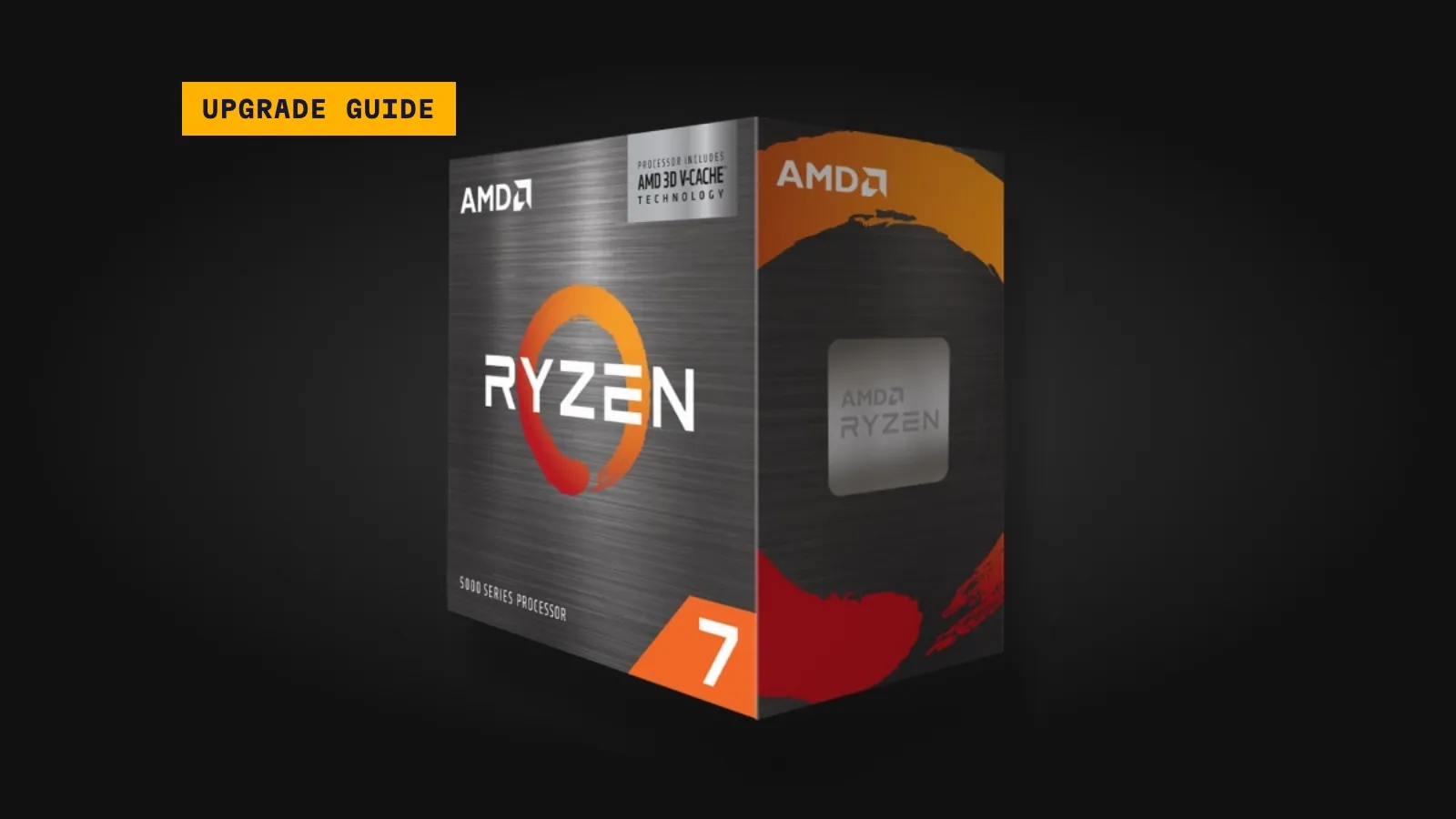
For most gamers on an AM4 board, the AM4 to AM5 upgrade is not worth it in late 2026. A Ryzen 7 5800X3D drops into the board and DDR4 you already own for $280 to $349 and matches a Ryzen 5 9600X in CPU-limited games. Moving to AM5 costs at least $768 before a motherboard, because 32GB of DDR5-6000 starts at $439.
TL;DR
- Own a 400 or 500 series AM4 board and DDR4? Buy the Ryzen 7 5800X3D and stop there.
- The sum: $279.99 to $349 for the 5800X3D, against $768 for a Ryzen 7 7700X3D and 32GB of DDR5, before the motherboard.
- The performance: in ComputerBase’s 15-game CPU test, the 5800X3D ties a Ryzen 5 9600X. A 7800X3D is 26% ahead and a 9800X3D is 43% ahead.
- Those gaps come from a 720p test with a flagship card. At 1440p with a mid-range GPU you will see far less.
- Go to AM5 if you are building from scratch, if your board has no Zen 3 BIOS, or if you own a flagship GPU and play at high refresh rates.
The standard advice used to be simple: skip the last AM4 chip and put the money into AM5. Memory prices have reversed that. The platform is still the better one; it is the entry fee that no longer makes sense for most people.
If you want a quick read on whether your current CPU is the problem at all, run your pair through our bottleneck calculator first. If your graphics card is the limit, no socket change helps.
Is the AM4 to AM5 upgrade worth it right now?
No, not for most people. An AM5 move means three purchases: the CPU, a motherboard and DDR5. The third one is the problem.
AMD relaunched the Ryzen 7 5800X3D as a 10th Anniversary Edition at $349, on sale from 25 June. It sold for $449 in 2022.
Street prices have been lower. TweakTown reported on 7 November 2026 that Micro Center had it at $279.99 against a $349.99 list price, with Best Buy at $349 and Amazon at $339.95. Check today’s price, because these move.
Memory is what hurts. The cheapest 32GB DDR5-6000 kit on one price tracker was $439 on 23 November 2026, and TrendForce expects conventional DRAM contract prices to rise another 10 to 15% this quarter. I go through the timing in should you buy RAM now or wait, and the technical differences are in DDR4 vs DDR5.
What does each path actually cost?
Staying put costs $280 to $349. Moving costs at least $768, and that figure leaves out the motherboard, which varies too much by chipset to average honestly.
| Path | CPU | Memory | Total |
|---|---|---|---|
| Stay on AM4 (5800X3D) | $279.99 (Micro Center, 7 Nov) to $349 list | Reuse your DDR4 | $279.99 to $349 |
| Move to AM5 (7700X3D) | $329 announced price (PCWorld) | 32GB DDR5-6000, $439 (tracker low, 23 Nov) | $768 before a board |
That is a $419 gap against the 5800X3D at list price and $488 against the Micro Center deal. For that money I would want a clear, visible improvement in the games I play, and for most setups it is not there.
What about the cheaper 5700X3D? PC Games Hardware relayed reports in August 2025 that it had reached end of life. If you find one new at a fair price, take it. Do not plan around it.
How much faster is AM5, really?
Less than the platform gap suggests, until you reach the X3D chips. ComputerBase tested the 5800X3D beside the AM5 range in November 2024, with an RTX 4090 at 720p across 15 games. I set the 5800X3D to 100 and averaged the per-game ratios.
| CPU | Socket | Average FPS (5800X3D = 100) | 1% lows (5800X3D = 100) |
|---|---|---|---|
| Ryzen 7 5800X3D | AM4 | 100 | 100 |
| Ryzen 5 9600X | AM5 | 100 | 104 |
| Ryzen 7 9700X | AM5 | 105 | 110 |
| Ryzen 7 7800X3D | AM5 | 126 | 130 |
| Ryzen 7 9800X3D | AM5 | 143 | 143 |
Read the second row again. A current Ryzen 5 9600X, on a new board with new memory, buys you nothing on average over the 5800X3D in that test. You have to step up to an X3D chip before AM5 pulls clear.
ComputerBase’s newer 2026 ranking, run on an RTX 5090, no longer includes the 5800X3D, but it shows the spread inside AM5.
| CPU (AM5 only) | Avg FPS | 1% low FPS | Index (7800X3D = 100) |
|---|---|---|---|
| Ryzen 5 9600X | 126 | 90 | 79 |
| Ryzen 5 7500X3D | 141 | 101 | 88 |
| Ryzen 5 7600X3D | 147 | 107 | 92 |
| Ryzen 7 7800X3D | 160 | 114 | 100 |
| Ryzen 7 9800X3D | 182 | 127 | 114 |
In that set the 7800X3D is about 27% ahead of the 9600X, and the 9800X3D about 14% ahead of the 7800X3D. The two tables use different games and different graphics cards, so compare within each, never across them.
Now the caveat that decides this. Both tests run at 720p with a flagship card so that the CPU is the limit. At 1440p with a mid-range GPU, the graphics card sets your frame rate and most of those gaps close. The exceptions are strategy and simulation games, and high-refresh play on a very fast card. Our 5800X3D vs 7800X3D comparison sets the two side by side.
One more figure from the 2026 set is worth keeping: the Ryzen 5 9600X loses about 10% of its average frame rate on a single memory stick. If you do move to AM5, do not save money by buying one module.
How do I do the AM4 drop-in upgrade safely?
Do the BIOS first. A new CPU on an old BIOS is the one way this upgrade can leave you with a PC that will not start.
- Write down your exact motherboard model and current BIOS version. Open the BIOS or run
msinfo32in Windows and read the ‘BIOS Version’ line. - Open your board maker’s CPU support list and confirm the 5800X3D (or your chosen chip) is listed, and which BIOS version it needs. If the chip is not on the list, stop here: this board cannot take it.
- Check power and cooling. The 5800X3D is a 105W part and the anniversary edition ships without a cooler, so confirm yours is rated for it. Run your parts through the PSU calculator if you are close on headroom.
- Back up, then save your BitLocker or device encryption recovery key and suspend encryption. A BIOS update can clear the security chip and lock Windows until you enter that key.
- Download the newest stable BIOS to a FAT32 USB drive and flash it with your old CPU still installed. Use the board’s built-in flash tool, not Windows, and do not power off mid-flash.
- After the reboot, re-open the BIOS and confirm the new version number. If it did not change, the flash failed. Do not swap yet.
- Run the PC for a few minutes so the old thermal paste softens, then power off and unplug it. Twist the cooler gently before you lift it, because AM4 chips can come out of the socket stuck to it. Lift the CPU lever. Match the corner triangle, seat the chip without pressure, and close the lever. Apply fresh paste and refit the cooler.
- Boot, re-enable your memory’s XMP or DOCP profile, and confirm the new CPU name and RAM speed in the BIOS. Then check temperatures under a game for ten minutes.
Note down any custom BIOS settings before flashing, since a flash resets them. Some BIOS releases trade away support for older CPUs to make room for newer ones, so read the vendor’s release notes before you flash.

Who should upgrade, and who should wait?
Stay on AM4 if you have a Ryzen 3000 or non-X3D Ryzen 5000 chip on a 400 or 500 series board and you play at 1440p with a mid-range card. The 5800X3D is the last sensible upgrade for that machine, and it keeps the DDR4 you already paid for. If you are weighing it against an entry AM5 chip, see Ryzen 5 7600 vs 5800X3D.
Go to AM5 if you are building new, if your board never got a Zen 3 BIOS, or if you own a flagship GPU and want a 7800X3D or 9800X3D to feed it. Do nothing at all if your graphics card is the limit; a faster CPU will not fix that.
Two things would change my mind: 32GB of DDR5 falling back toward $200, or the 5800X3D selling out. Until then, our CPU tier list shows where every chip here sits, and if a new graphics card is the better use of the money, check whether your PSU can handle it first.
FAQ
Is the 5800X3D still sold in late 2026? Yes. AMD relaunched it as a 10th Anniversary Edition with a $349 list price from 25 June 2026, per PCWorld. TweakTown saw it at $279.99 at Micro Center on 7 November.
Can an old AM4 board run a 5800X3D? Often, with a BIOS update, but support depends on the board maker. Find your exact model on the maker’s CPU support list and check the minimum BIOS version before you buy.
Is DDR4 still cheaper than DDR5? Yes. The same tracker lists 32GB of DDR4-3200 from $196 against $439 for 32GB of DDR5-6000 on 23 November 2026. Both are far above their 2025 prices.
Should I buy a 5700X3D instead? Only if you find one at a fair price. PC Games Hardware relayed reports in August 2025 that it was end of life, so stock is a matter of luck.
Will AM5 gain me much at 1440p? Less than benchmark charts suggest. ComputerBase’s tests run at 720p on flagship cards to expose CPU limits. A mid-range GPU at 1440p hides most of that gap.

Leave a Reply