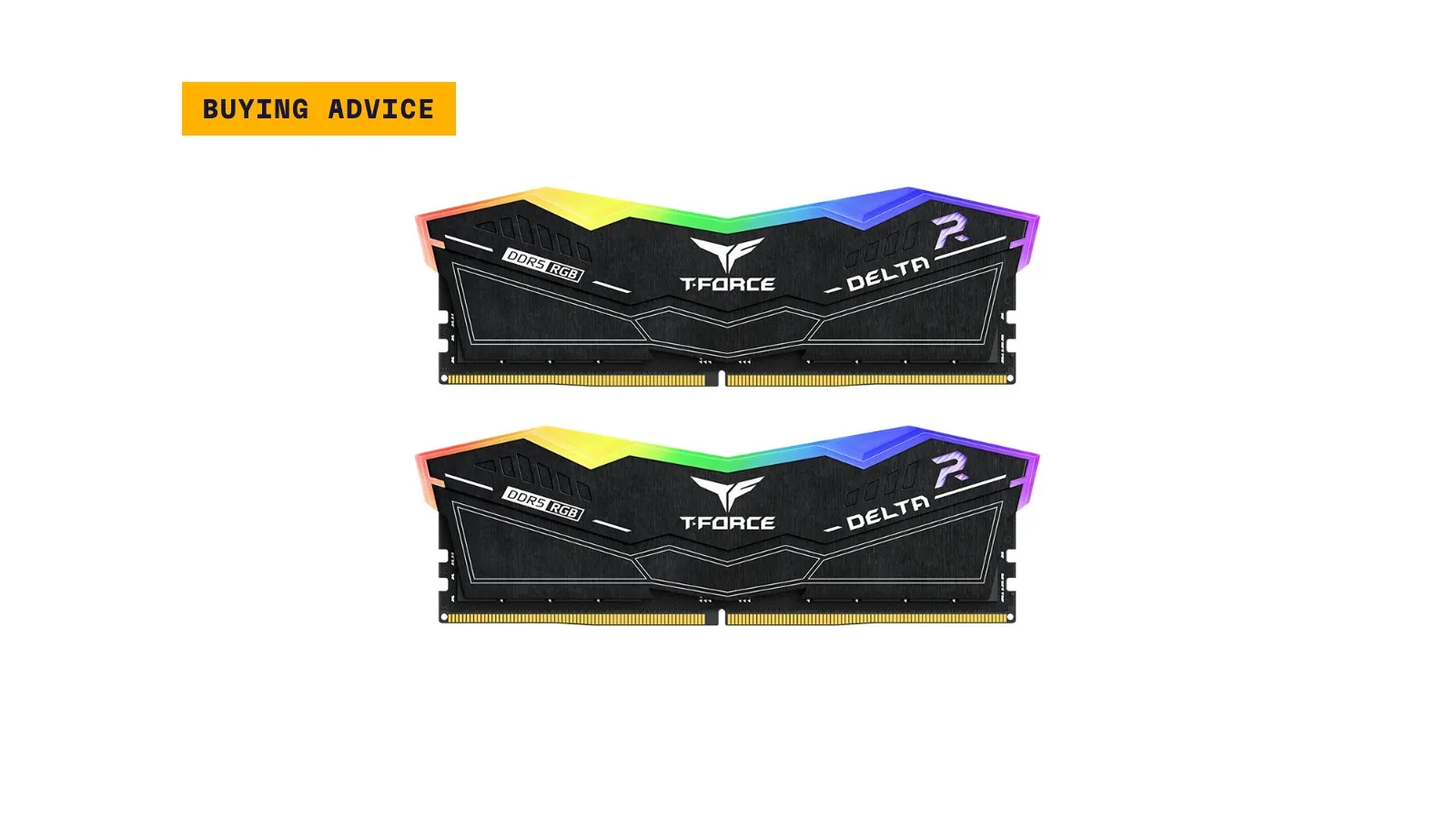
Buy now if you need memory in the next few months. TrendForce still expects DRAM contract prices to rise this quarter, Micron expects supply to stay tight through 2028, and no published forecast tracked by Capital & Compute has consumer prices falling in 2027. Buy only the capacity you need. Wait only if your current RAM works and you can live with it.
TL;DR
- Need RAM for a new build, a dead kit or a clear bottleneck? Buy this week.
- Waiting for Black Friday is a weak bet: last year’s RAM “deals” were often bundles that weren’t real discounts, and contract prices are still rising.
- Buy one 2x16GB DDR5-6000 kit for gaming. Skip 64GB and skip faster speeds.
- On DDR4 with a system that works? Don’t buy anything until a task actually fails.
- I’d change my mind if TrendForce reports flat or falling PC DRAM contract prices for a full quarter.
The usual advice on memory is to wait for a dip. I would not, this year. A 32GB DDR5-6000 kit sits around $439 at the cheapest end as of 23 November 2026, according to a price tracker. The forecasts I trust point sideways or up.
Should you buy RAM now or wait?
For anyone who needs RAM before spring, buy now. TrendForce’s 30 September release put fourth-quarter conventional DRAM contract prices up 10 to 15% on the quarter, with the pace of increases moderating. A 20 October TrendForce News item, citing Commercial Times, says about 20%. The two figures don’t match, and I’d treat both as “still rising, more slowly” rather than pick a winner.
Contract prices are what module makers and PC brands pay, not what you pay. Retail follows with a lag. So a slowdown in the rate of increase is not a price drop. TrendForce’s October PC DRAM summary says DDR5 prices are rising on tight advanced-node supply and that suppliers plan negative PC DRAM supply growth next year.
How bad are DDR5 prices compared with a year ago?
Roughly two to four times higher. The same tracker lists typical 32GB DDR5 kits at $100 to $200 in October 2025. Against that, $439 is 2.2x to 4.4x. A Notebookcheck report from 6 November 2025 has Crucial’s 32GB DDR5-5600 at $161.99. The tracker now shows 32GB DDR5-5600 from $499, which is about 3.1x that.
| Kit (lowest price found) | Price, 23 Nov 2026 | Earlier reference |
|---|---|---|
| DDR5-6000 16GB | $239 | n/a |
| DDR5-6000 32GB | $439 | $100 to $200 typical, Oct 2025 |
| DDR5-5600 32GB | $499 | $161.99 (Crucial), 6 Nov 2025 |
| DDR4-3200 16GB | $104 | n/a |
| DDR4-3200 32GB | $196 | $60 to $90 typical, Oct 2025 |
Source: the tracker above, which reports the lowest price it found at update time. Treat these as a floor. Capital & Compute put 32GB DDR5 at roughly $429 to $600 on 16 November and notes that the two trackers it uses disagree by about 50%, because they read different baskets. Check the total at checkout too, because an advertised low sometimes depends on a promo code.
Will Black Friday bring RAM prices down?
Don’t count on it. Last year is the best guide. Engadget’s 28 November 2025 check found no RAM promotions worth buying, and many bundles weren’t real discounts against price trackers. Its example was a Crucial 32GB bundle at $322 on Amazon, up from $175 a little over a month earlier.
Supply is also thinner at the consumer end. Micron announced its exit from the Crucial consumer business in December 2025, with consumer shipments continuing only through February 2026. One of the largest consumer memory brands has left the shelf. A genuine 10 or 15% off code on a mainstream kit is plausible. A return to 2025 prices this week is not.
Is the shortage going to ease soon?
Not before 2028 on the best reading. Micron’s fiscal fourth-quarter prepared remarks say it expects memory and storage supply-demand conditions to be much tighter in calendar 2027 and 2028 than in 2026. It sees industry DRAM bit shipments growing in the low 20s percent in both years, and the industry staying supply constrained.
TrendForce’s 6 October roundup adds that Micron’s first new capacity arrives in 2027, a second wave lands in the second half of 2028, and relief will be gradual. SK hynix’s CEO said the chip supply shortage could persist through 2030.
Could prices fall anyway? Memory is a cyclical business, and a surprise can’t be ruled out. But Capital & Compute reports that no published forecast has prices falling in 2027. That’s not a basis for sitting on a broken PC.
How do you decide whether you need more RAM?
Measure first, then buy. Here is the order I’d follow.
- Open Task Manager, go to Performance, then Memory. Note the total, the speed and “Slots used”. Success is knowing whether you have an empty slot. Task Manager doesn’t reliably name DDR4 or DDR5, so confirm the type on your motherboard’s spec page.
- Run your heaviest normal session for 20 minutes: the game plus Discord and a browser, or your editing project. Watch “In use” in the same Memory panel. If it stays well under your total, you don’t need more.
- Check for symptoms that point at RAM, not the GPU or drive: the “In use” figure pinned near the total, a “Committed” figure well above physical RAM, or heavy disk activity while the game stutters. If you see none of them, stop here.
- If you do need more, pick the capacity. For gaming, price a 2x16GB kit first. In NoobFeed’s January 2026 tests across seven games, average frame rates usually differed by a few frames per second between 16GB and 32GB, and 32GB generally gave smoother 1% lows. Success is a kit that matches your heaviest workload, not the biggest one on the shelf.
- Match the platform. DDR5 only goes in DDR5 boards, and DDR4 only in DDR4. Our DDR4 vs DDR5 guide covers which CPUs and boards take which. AM5 boards take only DDR5.
- Buy a single matched kit, not two separate pairs, and compare the price per gigabyte against the table above. Success is a kit that is on your board’s memory support list and matches its DDR generation.
- Shut down, switch off the PSU and unplug it, and touch bare case metal to discharge static. Open the clips on the slots your motherboard manual names for two DIMMs (usually the second and fourth slots from the CPU), then press each module in until both clips click. Success is both modules sitting flush.
- Boot. The first start can take a minute or more while the board trains the new memory, so don’t cut the power. Then enter the BIOS, enable the EXPO or XMP profile, save, and check Task Manager’s Speed field. Success is seeing the rated speed instead of a lower default.
How much should you buy, and what should you skip?
At the cheapest listed prices, 16GB of DDR5-6000 costs $239 and 32GB costs $439. That’s $200 more for the second 16GB, or about $13.72 a gigabyte against $14.94. The bigger kit is better value per gigabyte, but not if your sessions never need it.
Skip 48GB, 64GB and above unless you edit video, run virtual machines or compile large projects. The same tracker lists 64GB DDR5-6000 at $949 and 96GB at $2,049. Skip speeds above DDR5-6000 as well: 6600 32GB lists at $673, $234 more than the $439 kit. If your frame rate is the real problem, memory will not fix it: check how your CPU compares and how your GPU compares first, or start with our CPU tier list.

What if you’re on DDR4?
Don’t buy anything unless something is failing. DDR4-3200 32GB lists at $196, which is about 2.2x to 3.3x the $60 to $90 the tracker gave for October 2025. A 16GB DDR4 kit at $104 is still a far smaller bet than a $439 DDR5 kit plus the board and CPU a switch would force.
This is the main reason the AM4 to AM5 upgrade question is harder than it was a year ago. If you’re sitting on a Ryzen 9 5950X or similar, see our Ryzen 9 5950X RAM guide for what’s worth buying in DDR4. Storage is squeezed too: Micron’s prepared remarks put its fiscal Q4 NAND price increase at about 30%, and our DRAM vs HMB SSD guide covers drive choices.
The verdict: who should buy, and who should wait
- Buy this week: new builders, anyone with a failing or too-small kit that is hurting real work, and anyone whose build is stalled waiting on memory. Take the lowest verified price on a 2x16GB DDR5-6000 kit and move on.
- Buy only if the price is right: upgraders who want 32GB for comfort. If a mainstream kit drops well under the $439 floor (my own line for a real deal is about $350, not a forecast), grab it. Don’t chase the last $20.
- Wait: anyone whose current RAM runs everything they do. The risk of waiting isn’t zero, but you lose nothing while the machine works. Expect to wait until 2028 for real relief.
What would change my mind: TrendForce reporting flat or falling PC DRAM contract prices for a full quarter, or Micron’s 2027 capacity arriving ahead of plan. Neither is in evidence as of 24 November 2026.
FAQ
Is it a good time to buy RAM in November 2026? It’s a bad time to buy RAM you don’t need and a reasonable time to buy RAM you do. Prices are far above 2025 and TrendForce expects contract prices to keep rising this quarter, so waiting is a weak bet.
Will RAM prices drop after Black Friday? Unlikely. TrendForce expects fourth-quarter contract prices to rise, and Engadget found last year’s Black Friday RAM offers were often bundles that weren’t real discounts against price trackers.
When will RAM prices come down? Micron expects the industry to stay supply constrained through 2028, with a second wave of its new capacity due in the second half of 2028. SK hynix’s CEO has said the supply shortage could persist through 2030. Expect relief to be gradual.
Is 16GB of RAM enough for gaming in 2026? For most games, yes. In NoobFeed’s January 2026 tests across seven games, average frame rates usually differed by a few frames per second, though 32GB generally gave smoother 1% lows. It is a reasonable stopgap while prices are high. Choose 32GB if you multitask or edit video.
Should I buy DDR4 instead of DDR5 to save money? Only if your board already takes DDR4. DDR4-3200 32GB lists at $196 against $439 for DDR5-6000, but the two don’t fit each other’s slots. Switching means a new board and, on AMD, a move from AM4 to AM5.


Leave a Reply